

Note: This is a memo prepared by SAFA, working with a number of NIH affiliates (in their personal time) and in consultation with outside lawyers. It is below as a post, and also available as a PDF. Please read, and take action — this is important.
The Trump administration has repeatedly interfered inside NIH, including by terminating funding for thousands of projects. A Reagan-appointed trial court judge found that hundreds of these grant terminations were ‘breathtakingly’ illegal and ordered NIH to immediately reinstate them. Now, the Trump administration has appealed this reinstatement order to the Supreme Court. The Supreme Court will make a decision on the stay request soon on the shadow docket, where the Court issues often unsigned decisions, at unpredictable times, providing little or no reasoning. The Supreme Court has been behaving in a ‘lawless’ and political fashion, according to many legal experts (see FAQs below), and the Court seems likely to stay the trial court’s order, allowing the Trump administration to re-terminate the grants. A Supreme Court stay would throw NIH into further chaos, harming efforts to award many other grants.
What can we do now? The Supreme Court responds to public pressure. We can speak out in every venue available. Tell the Supreme Court the public is watching. Let’s demand: No Stay. And demand the Court and Trump administration keep their Hands Off NIH.
1. NIH grant terminations, now before the Supreme Court
The National Institutes of Health (NIH) is the world’s largest biomedical research funder. It is the backbone of America’s science research industry. NIH is a major contributor to the health of Americans and to the US economy.
The Trump administration has interfered politically inside NIH to terminate health research grants. These terminations are unprecedented, and are endorsed and likely directed by Project 2025 and Trump OMB head Russell Vought. These terminations are devastating, stopping critical research on diseases including cancer and Alzheimer’s. The terminations have also decimated biomedical training, ending support for high school, undergrad, and graduate students from all backgrounds.
Many Trump NIH grant terminations are illegal. A Reagan-appointed federal trial court judge found that hundreds of grant terminations by this administration, including grants for research relating to HIV, diversity, public opinion, and COVID, violated a foundational US federal agency law that bars arbitrary and capricious agency actions. The judge, William Young, said the terminations were "breathtakingly” arbitrary and capricious. The judge also noted the terminations were discriminatory: “I’ve sat on this bench now for 40 years. I’ve never seen government racial discrimination like this.” The Trump Administration appealed Judge Young’s reinstatement order to the appellate court. The First Circuit Court of Appeals rejected a stay request, and left in place Judge Young’s order barring the terminations.
Trump appealed to the Supreme Court, on the shadow docket. After the 1st Circuit refused to put Judge Young’s reinstatement order on hold, the Trump administration appealed to the Supreme Court, asking to stop (stay) the judge’s order and re-terminate the research grants. The Supreme Court has used the shadow docket, with its unsigned orders, to uphold much of Trump’s Project 2025 agenda.
The Court is likely to reinstate the Trump grant terminations, with devastating effects on science. In a different case involving the Department of Education, the Supreme Court allowed Trump grant terminations to proceed by issuing a stay based on a technicality over jurisdiction. The Court said that federal district courts are not the right place to sue about grant claims, and the case should have instead been brought in the Court of Federal Claims. Critically, in that case the Supreme Court also issued a stay, allowing the grant terminations to continue. This is, in effect, backing Trump. The First Circuit opinion describes how this technicality does not apply to the NIH grants. But the Supreme Court will likely make the same move here as in the Department of Education case: grant a stay via the shadow docket. That decision could be released at any time in the next few days or weeks. If a stay is issued, NIH staff will be pulled onto re-terminations, slowing all other grant awards. And if SCOTUS overrules the lower court, explicitly or implicitly via a stay, that will likely justify Trump terminations of other NIH grants.
What can we do? Write to newspapers, take to social media, hold events. Make noise. “No stay. Hands off NIH, SCOTUS.”
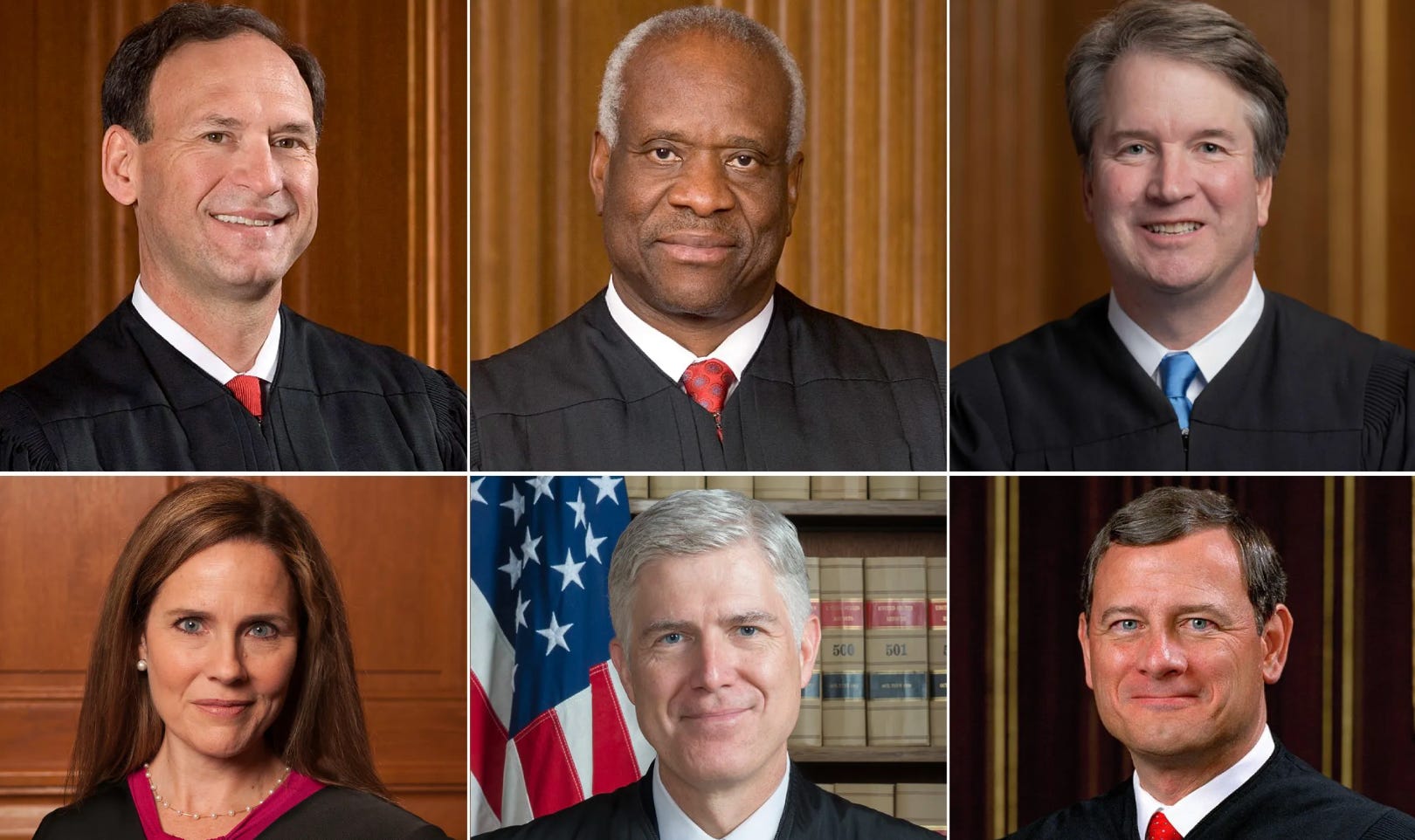
The Court is a political body that responds to public opinion. In fact, Brett Kavanaugh last week “made clear he closely follows press coverage, podcasts, and social media posts about the Supreme Court.”
Too often the public has shied away from criticizing the Court. Some of that is due to legal complexity that SCOTUS hides behind. But this situation is simple.
Let’s all say it: No Stay. Judge Young is right. The grant terminations are illegal.
2. Frequently Asked Questions
What can the Supreme Court do? What’s a stay? What’s the “shadow docket”? The Supreme Court’s shadow docket, or emergency docket, has long been used for emergency matters that would result in irreversible damage if the Court does not intervene. However, the shadow docket has been used—exploited—in the past decade by the Court’s conservative supermajority to “amass power [for the Court], and undermine the Republic.” In this NIH case, the danger, and a likely outcome, is the Court will issue a stay of Judge Young’s order and allow the grant terminations to proceed. It could then take many months for the appellate court and Supreme Court to issue full opinions. By then, the damage to science will be done. Shadow docket stays are a way for the Court to back Trump and the Project 2025 agenda, while wrapping the court’s action in flimsy justification that hides what is really happening: the Court is backing Trump.
How bad is this Supreme Court, really? It is very, very bad. The Court has ruled in favor of Trump on the shadow docket in 17 straight cases. The actions of the Court this year have been described, in quotes from different parties, as “lawless,” “mak[ing] a mockery of the careful work responsible district judges do,” “utterly lawless,” “a lawless rubber stamp for Trump’s authoritarian agenda,” “unerringly blessing Trump’s power grabs,” “facilitat[ing] [Trump’s] abuses of power by expanding executive authority to new heights,” “lawless,” and.. (you guessed it) “lawless.”
The conservative justices have been called, by establishment scholars, “lawless utter extremist partisan hacks,” and their shadow docket orders called “nonsense.” In these cases the conservative supermajority on the Court is not doing legal reasoning. It is back-filling legal arguments to enable the Trump/Project 2025 agenda. It certainly appears the Court conservative supermajority does this because it is composed of Republican politicians who agree with Trump politically. (Some speculate another major reason is to preserve the power the Court has accrued to itself.)
But we, as the public, should try to avoid being sucked deep into legal arguments. Instead, just say: the grant terminations are illegal, the district court and First Circuit made that clear, and the Supreme Court should not issue a stay.
When will the shadow docket decision come down? There is no deadline to issue orders on the shadow docket, so the timing is unknown. The Court requested information due August 1st, and an order could be issued at any time now: in days, or as long as months from now. To draw public attention to this, the best time to speak about this to the public is now.
How might the Supreme Court justify a stay? When shadow docket orders are issued, no justification is required, so there may be no reasoning at all. But we may get some explanation, as we have seen in prior shadow docket rulings this year. While it is impossible to predict what the Supreme Court will use as its legal arguments, there are two pieces of information that suggest the Court will wave its hands, cite a technicality, and say Judge Young did not have the right to rule on this case.
The first indication comes from the Supreme Court’s shadow docket unsigned order about grant terminations in April, in Dept of Education v. California. The Court cited an 1887 law, the Tucker Act, which says that any claims against the federal government involving “money damages” must be brought in the Court of Federal Claims. A similar finding would mean Judge Young’s ruling in a federal district court would be invalid, and the plaintiffs would need to sue again in another court. Both Judge Young and the First Circuit convincingly argued in their decisions why this Tucker Act theory did not apply, but the Supreme Court could easily throw this aside.
There is a second hint the Court will use this legal reasoning: a Trump-appointed district judge in New York recently ruled that an NSF grant case must be taken to the Court of Federal Claims under the Tucker Act. That judge, John Cronan, is a Federalist Society (FedSoc) member. The FedSoc community is one place where novel legal theories that support Republican political ends are developed, workshopped, and exchanged. The New York judge’s decision could be plausibly read as a signal that the FedSoc community, including the FedSoc-aligned judges on SCOTUS, has settled on this approach to kill legal challenges to the Trump/Project 2025 grant terminations. Whatever legal justification the Supreme Court might concoct to give them cover to protect Trump, our message to the public now is simple: “No Stay. SCOTUS: Stop Backing Trump’s Project 2025.”
The GAO just found Trump’s grant terminations at NIH illegal. How does that affect this case? The GAO report does not very much affect the case in front of the Supreme Court now; the case that Judge Young decided. The GAO is a legislative branch agency that supports Congress. GAO found on Aug 5th that Trump violated the law in terminating NIH grants. But that violation was based on a different legal principle from the one at issue here. The current Supreme Court case was decided based on violations of the Administrative Procedure Act, where the actions to terminate the grants were made in an arbitrary way. The GAO report found that the Trump administration had violated appropriations, or budget, law by impounding — illegally withholding — spending. So the grant terminations are, in some sense, doubly illegal. But when the Supreme Court issues its shadow docket decision, it will be reasoning based on the APA claims, not the impoundment issues described in the GAO report.
But if the Supreme Court says what Trump is doing is legal, how can we argue with them? The Republican appointees on the Supreme Court have effectively rewritten many American laws over the past 15 years, from the Voting Rights Act, to laws affecting bribery, fraud, guns, discrimination, public health, unionization, agency function, regulatory power, dark money donor disclosure, abortion rights, and money in politics. Part of the reason they have been able to change the law and Constitutional interpretation so effectively is their actions hide behind often-complex legal theories. The Court has been able to legislate in this way in part because they have cultivated a situation where only a small set of highly experienced lawyers gets to weigh in on what the law says. To stop the Court from imposing the Trump political agenda on us, we can and should stand up for broad legal and Constitutional principles. In fact, one school of Constitutional law, “popular constitutionalism,” holds that the Constitution derives its legitimacy and meaning from the public, not merely from the small circle of legal experts that engages with the courts. If the Supreme Court grants a stay in this case, it will be shredding fundamental principles of the Constitution, including on Congressional power of the purse and discrimination. And we should say that: “No Stay. SCOTUS: Stop Backing Trump’s Project 2025.”
What kind of NIH grants are at issue in this case? The Trump Project 2025/DOGE effort has cancelled hundreds of NIH research and training grants. Many grants addressed workforce diversity, health equity, or LGBTQ+ health. Others were large program grants to perform cancer or brain research and had no main so-called “DEIA” purpose — they merely had some effort or statement on increasing scientific workforce diversity, or included all patient groups. Yet other grants were critical HIV research and their termination harms patients and acts to discriminate against LGBTQ+ populations. Terminations also include rigorous research addressing racial, ethnic, and gender health disparities that were censored for using words the administration does not like, or training grants to scientists in rural areas or with disabilities. Still other terminated grants were those awarded to investigators from racial, ethnic, or gender groups underrepresented in science, who competed successfully against the entire pool of applicants—with no special advantage—and were terminated just for being associated with money designed to enlarge the scientific talent pool (Life Sciences Trial Brief, at 9).
My grant wasn’t affected in this case. Why will this SCOTUS case affect me?
It would increase burden on already overwhelmed NIH staff. Any further interference at NIH, any re-termination by SCOTUS, will gum up the works at NIH. NIH staff are near the breaking point. This will increase their workload even further, and that will put all award actions at risk. If you are waiting on an NIH award, this affects you! Trump's frequent policy changes have already created substantial delays in NIH funding, and NIH staff are scrambling, racing against the clock to get out awards before funds expire at the end of the fiscal year. Every delay matters.
It would confirm that an NIH award is no longer a commitment that scientists can trust. If the Supreme Court grants the stay, it supports the idea that NIH can arbitrarily cancel grants made by the prior administration — or change its mind about its prior awards. But long-term planning and certainty are key for science. (Life Sciences Brief, at 4) These political grant terminations will break the incredibly successful partnership between NIH and academia that has yielded biomedical breakthroughs, like the miracle cystic fibrosis drug that has allowed Russell Vought's daughter to expect a long and better life.
The affected science—and science labs, built on expertise developed over decades—may not survive these disruptions. Science in the US is already teetering on a cliff. If the Supreme Court grants the stay, labs will close and careers and US scientific research capacity will be lost.
Is the Supreme Court really a political body? Isn’t it gauche to criticize respected judges? Don’t we need to respect the Supreme Court in order to protect rule of law? As law professor Eric Segall has argued, “The Supreme Court is Not a Court, and The Justices Are Not Judges” — instead, the Court acts like a super-legislature and the judges act like politicians. As another law professor, Josh Chafetz, put it: “The judges are out of control.” The US Supreme Court now does not function as a constitutional court that decides narrow legal issues. Some of the reasons that SCOTUS is so influenced by politics include: that there are a small number of lifetime judges (so parties to cases can plan sophistic ‘legal theories’ years in advance to flatter specific judges), and that it can choose almost any issue to rule on. The composition of the court is also broken: that there has been a multi-decade Federalist Society/Leonard Leo effort by the right, funded by billionaires, to find lawyers that agree with them, groom them, and elevate them to the Court. Because liberals did not do the same, the Court now is not just Republican-biased, but it is doing politics and legislating from the bench. Given the lawless Court, protecting the rule of law in fact requires criticizing the Court, not standing aside while they shred our laws and enable a lawless president to shred our government.
3. References and further reading
Sources are highlighted with ⏩ are of particular interest for those wanting to learn more.
Shadow Docket reading
“The Shadow Docket: How the Supreme Court Uses Stealth Rulings to Amass Power and Undermine the Republic,” 2023 book by Prof Steven Vladeck
⏩“The Supreme Court and the Shadow Docket”, NPR, 2023
Case documents with information about Trump NIH actions and findings of law
Amicus brief: AAMC and university organizations, Supreme Court emergency docket
⏩ Amicus brief: 4 Leading Life Sciences Organizations, Supreme Court emergency docket -> This is a stellar brief that describes impact on science and the US, with one part highlighting the massive damage to the workforce and training pipeline.
Amicus brief: 4 Leading Life Sciences Organizations, District Court docket
⏩Judge Young decision -> Contains many emails and records from the Trump NIH that document the breathtakingly political actions to disrupt US science. Summary thread on bluesky from Max Kozlov at Nature News.
First Circuit decision on the stay request -> The judges in this decision persuasively argue against and pre-empt the probable SCOTUS Tucker Act order.
Dockets
Other context
⏩Supreme Court Lets Trump Enact His Authoritarian Agenda on Its ‘Shadow Docket’, Court Accountability
⏩The New Judicial Power Grab, Georgetown law professor J Chafetz, 2023.
Excerpt; the Supreme Court as a political actor:
“The judiciary is an institution. This should strike everyone as obvious. And yet, … scholarly discourse about the Supreme Court has moved away from its institutional aspects [ed: political nature] in favor of a disembodied focus on its doctrinal outputs [ed: the law]. This deleterious turn in scholarly treatment of the courts has taken its lead from judges themselves, who routinely deploy a number of techniques to conceal their institutional situatedness. They present themselves as standing outside of space, time, and politics. They obscure the fact that courts are staffed by human beings [...], so that we are invited to see them (and to refer to their highest ranks) as “Justice” incarnate or as “the Court.” And they hold themselves out as a pure, reason-based alternative to the messy business of the “political branches” in a manner that serves precisely to empower their own institution vis-à-vis the other branches in the game of constitutional politics.”
Thanks for reading. To stay in touch with us, please subscribe. For press questions or for organizations wanting more info, please contact us via email: info@scienceandfreedomalliance.org


What’s missing here is an actual link to act. Don’t just tell people the issue, include easy access to do it.
Need a petition to sign or a scripted letter for disabled people, like me, who aren’t up to writing individual letters to SCOTUS, please.